The Sun Rises Again the Seasons Go Round
The seasons accept nothing to do with how far the World is from the Sunday. If this were the case, it would be hotter in the northern hemisphere during January as opposed to July. Instead, the seasons are caused by the Earth being tilted on its axis by an average of 23.5 degrees (World'southward tilt on its axis actually varies from virtually 22 degrees to 24.five degrees). Hither's how it works:
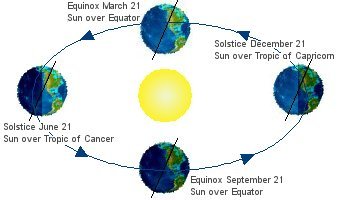
The Earth has an elliptical orbit around our Sun. This beingness said, the Earth is at its closest signal altitude wise to the Sun in January (called the Perihelion) and the furthest in July (the Aphelion). But this distance change is non slap-up enough to crusade any substantial difference in our climate. This is why the Earth's 23.5 caste tilt is all of import in changing our seasons. Near June 21st, the summer solstice, the Earth is tilted such that the Sun is positioned directly over the Tropic of Cancer at 23.5 degrees north latitude. This situates the northern hemisphere in a more directly path of the Sun's energy. What this ways is less sunlight gets scattered before reaching the ground because information technology has less distance to travel through the atmosphere. In addition, the high sunday angle produces long days. The contrary is true in the southern hemisphere, where the low lord's day bending produces short days. Furthermore, a big amount of the Sun'southward free energy is scattered earlier reaching the ground because the energy has to travel through more of the atmosphere. Therefore well-nigh June 21st, the southern hemisphere is having its winter solstice because it "leans" abroad from the Dominicus.
Advancing 90 days, the World is at the autumnal equinox on or about September 21st. Equally the Earth revolves around the Dominicus, information technology gets positioned such that the Dominicus is direct over the equator. Basically, the Dominicus's energy is in balance betwixt the northern and southern hemispheres. The same holds true on the jump equinox near March 21st, equally the Sunday is one time again directly over the equator.
Lastly, on the winter solstice near December 21st, the Lord's day is positioned directly over the Tropic of Capricorn at 23.5 degrees south latitude. The southern hemisphere is therefore receiving the direct sunlight, with piddling scattering of the sun'due south rays and a loftier sun bending producing long days. The northern hemisphere is tipped away from the Sun, producing short days and a low sun angle.
What kind of effect does the earth's tilt and subsequent seasons have on our length of daylight (defined as sunrise to dusk). Over the equator, the answer is not much. If you live on or very close to the equator, your daylight would be basically within a few minutes of 12 hours the yr around. Using the northern hemisphere as a reference, the daylight would lengthen/shorten during the summertime/winter moving due north from the equator. The daylight difference is subtle in the torrid zone, but becomes extremely large in the northern latitudes. Where we live in the mid latitudes, daylight ranges from nearly xv hours around the summer solstice to about nine hours close to the winter solstice. Moving to the arctic circumvolve at 66.v degrees northward latitude, the Sunday never sets from early on June to early July. Just around the winter solstice, the daylight only lasts slightly more two hours. There becomes a profound difference in the length of daylight heading n of the arctic circle. Barrow, Alaska at slightly more than than 71 degrees northward latitude, lies just less than 300 nautical miles n of the arctic circle. Barrow sees two months of total darkness, as the Sun never rises for about a calendar month on each side of the wintertime solstice. On the other paw, Barrow also has total light from mid May to early August. And what about the due north pole, or xc degrees due north latitude? The Dominicus rises in the early on evening well-nigh the bound equinox and never sets again until just after the autumnal equinox, or six months of light. Conversely, later on the Sun sets in the mid morning just afterwards the autumnal equinox, it will not be seen again until the following spring equinox, equating to 6 months of darkness.
Source: https://www.weather.gov/fsd/season
0 Response to "The Sun Rises Again the Seasons Go Round"
Enviar um comentário